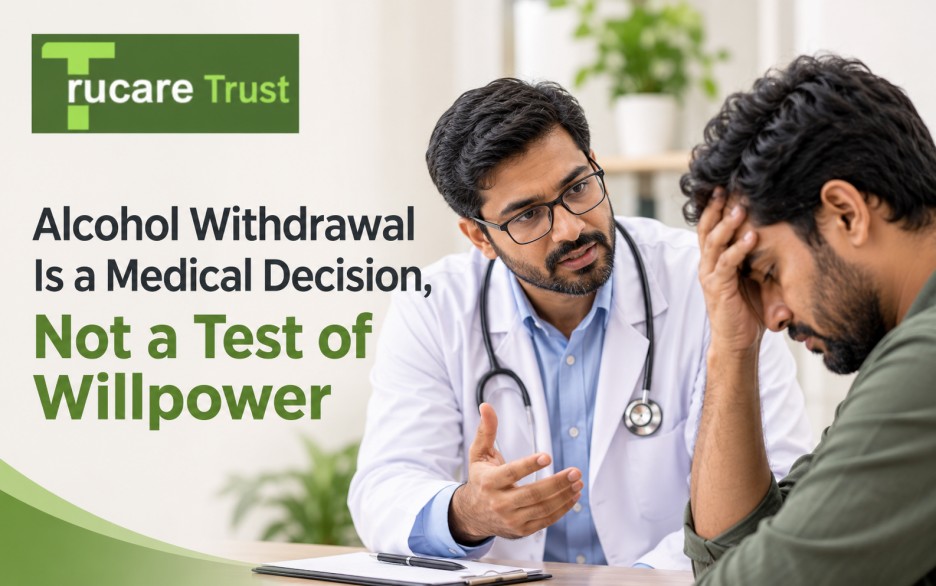
After a tense weekend, a family may decide that drinking must stop completely from Monday morning. The intention is understandable. For a person with significant physical dependence, however, abrupt stopping can be dangerous. Shaking, sweating and anxiety may be early symptoms; seizures, severe confusion or delirium tremens require emergency medical care.
That is why the first question at a treatment enquiry should not be ‘How quickly will the person become sober?’ It should be ‘Who will assess withdrawal risk, and what is the plan if complications develop?’
According to the World Health Organization’s 2024 alcohol fact sheet, alcohol consumption contributed to about 2.6 million deaths worldwide in 2019. This is not a tally of deaths from withdrawal. It reflects the much wider burden of disease and injury, including liver illness, cancers, cardiovascular damage and accidents. India’s 2019 national substance-use survey, conducted through AIIMS and reported by the government, estimated that 5.2% of the surveyed population aged 10-75 had harmful or dependent alcohol use. The two statistics measure different things and should not be combined.
A common request to an Indian treatment service is, ‘Can we admit him today and stop the drinking straight away?’ Urgency is understandable, particularly when work, driving or family safety has been affected. Yet a centre cannot safely promise home detox or overnight abstinence without knowing the withdrawal history and medical condition. If a person has previously had seizures, hallucinations or severe confusion after cutting down, discuss hospital-based assessment before arranging transport to a residential centre. For a medical emergency in India, 112 is the national emergency response number; waiting for a routine appointment is not appropriate when someone is fitting, delirious or difficult to wake.
Why a clinical assessment comes before detox
A qualified clinician should ask about the usual amount of alcohol consumed, morning drinking, previous withdrawal symptoms, seizures, other medicines, liver disease and mental-health concerns. Nutrition matters too. Some dependent drinkers have vitamin deficiencies, including thiamine deficiency, which can contribute to serious neurological harm. Medication and vitamin treatment are clinical decisions; families should not improvise them from online advice.
NICE guidance on alcohol-related physical complications recommends hospital care for people in withdrawal who have, or are at high risk of, seizures or delirium tremens. It also warns that sudden reduction can be hazardous in dependent drinkers. Anyone with seizures, severe confusion, hallucinations, repeated vomiting or significant medical instability needs urgent hospital assessment, not an ordinary admission appointment.
A responsible provider of alcohol addiction treatment should explain how medical evaluation, withdrawal management and psychological care connect. Some people can be managed in the community with suitable supervision. Others require hospital-based withdrawal care before they are ready for residential rehabilitation. ‘One package fits everyone’ is not a credible clinical plan.
Detox deals with the immediate risk. Recovery takes longer.
After withdrawal settles, a person may still struggle with cravings, old drinking routines or pressure from friends. NICE’s guidance for moderate to severe dependence discusses evidence-based psychological treatment and, for selected patients, medicines such as acamprosate or naltrexone prescribed by an appropriate clinician. Family support, relapse planning and follow-up appointments also matter. A discharge date does not mark the end of treatment.
Someone comparing alcohol rehabs should ask to see the admission process in plain language. Are staff available to recognise deterioration? Which services manage emergencies? Who prescribes medication? What happens if depression or another substance problem is discovered? How are relatives involved without overriding the patient’s privacy?
What the family should tell the doctor, even if it feels uncomfortable
A medical team needs an honest picture of drinking, including morning drinks, periods when the person could not stop, and the date and time of their last alcohol intake. Tell them about previous tremors, seizures or hallucinations, any sedative tablets, liver problems, diabetes and injuries. If the individual has been drinking alcohol while taking prescribed medicines, that too matters. Concealing details out of fear of judgement can lead to the wrong level of monitoring.
Withdrawal is not always predictable from appearance. Someone who walks into a clinic and holds a steady conversation may still have risk factors for serious complications. Conversely, an individual with harmful drinking but no physical dependence may not require the same medical withdrawal procedure. Assessment separates these situations; an online questionnaire alone cannot.
Why vitamins, observation and a transfer plan are clinical issues
Long-standing harmful drinking may contribute to poor nutrition and thiamine deficiency. In vulnerable people, deficiency can cause Wernicke’s encephalopathy, a serious neurological condition. This is one reason clinicians assess nutritional status and may prescribe thiamine. It is not a reason for families to attempt unsupervised injections or guess medication doses. Staff should know how to recognise confusion, difficulty walking or eye-movement problems, and when immediate hospital assessment is needed.
Ask who monitors vital signs during withdrawal, how often patients are reviewed and what happens if they deteriorate at night. A centre should identify its limitations openly. For higher-risk patients, NICE CG100 recommends hospital admission for medically assisted withdrawal. Emergency transfer arrangements are more meaningful than a broad assurance that a facility handles ‘all cases’.
The conversation that belongs after detox
Once medically stable, the person needs choices rather than a lecture. A clinician can discuss cravings, mood symptoms, relationships, work pressures and whether medication to support reduced drinking or abstinence is appropriate. Some patients benefit from structured psychological care; others need more intensive support because several conditions occur together. Medication selection depends on clinical history, liver or kidney health, other prescriptions and patient preference.
Plan around a normal Friday evening, not only the days spent in treatment. Who will the person call when colleagues invite them for drinks? What will they tell a relative who offers alcohol at a celebration? Is there a follow-up appointment and a clear response to a lapse? The safest programme connects the immediate medical task with these everyday decisions. Without that connection, completing withdrawal can feel like finishing treatment when it was actually the beginning.
The safest decision is not always the closest centre or the longest stay. It is the level of care matched to actual risk, followed by enough support to make life without harmful drinking manageable. That starts with a proper assessment, not a promise of instant recovery.